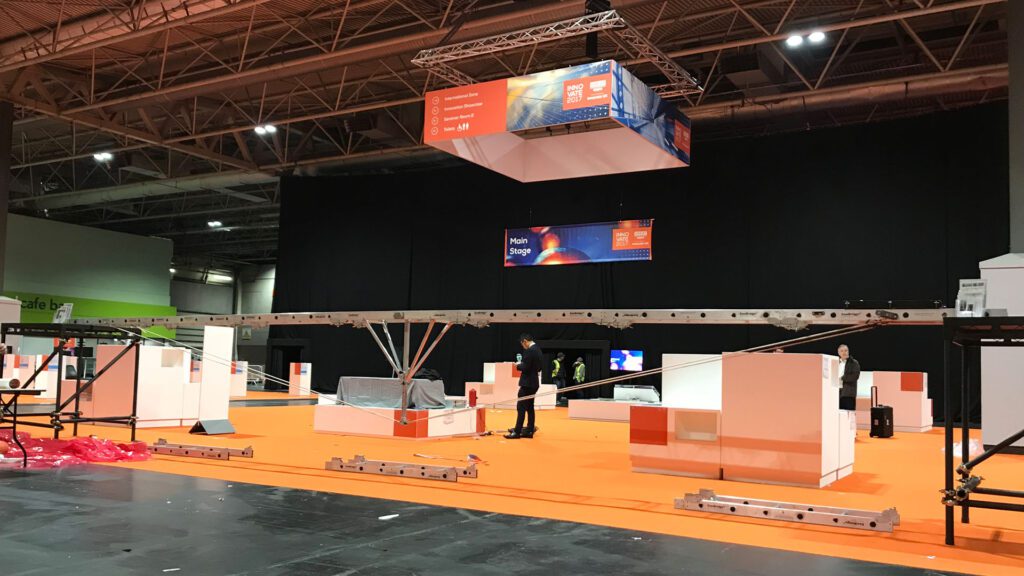
In November 2017, the UK government’s flagship annual innovation showcase — Innovate 2017 — opened at ExCeL London, bringing together the country’s brightest innovators alongside ministers, industry leaders and investors. Among the exhibitors launching new products to the public for the very first time was Bright Structures Ltd., a one-man micro-SME from Devon, with its EasiBridge portable bridging system.
The official UK government record of the event, published on GOV.UK by Innovate UK on 8 November 2017, singled EasiBridge out by name among the standout new product launches of the day: “a portable ‘Easibridge’ system for applications such as evacuation and rescue, from Bright Structures. A 16 metre bridge can be installed and crossed by just one person in under 30 seconds.”
It was striking company to be in. The same event saw the launch of a £50 million Innovate UK innovation loans programme by Chief Executive Ruth McKernan, a keynote from Minister of State Claire Perry committing £68 million to robotics and AI projects, and the annual Design in Innovation Award. EasiBridge — a bridge built from ladder sections, deployable by a single person in under half a minute — stood out precisely because it was so immediately useful, so tangible, and so unlike anything else on the floor.
For Dr. Stephen Bright, the appearance marked the first time EasiBridge had been publicly showcased to the wider UK innovation and investment community. It came in the same year as the Army Warfighting Experiment demonstration and the Indian Army trial — a year that transformed EasiBridge from a privately funded prototype into a system attracting serious attention on multiple fronts simultaneously.
As the Think Defence article published six months later confirmed, all EasiBridge development to that point had been financed entirely in-house, with support from Innovate UK and early MoD DASA development grants. The Innovate 2017 platform helped build the institutional credibility that would attract the formal DASA Rapid Innovation Grant of £77,086.80 in July 2018, the first military order from the Royal Engineers in 2019, and everything that followed.
Source: GOV.UK / Innovate UK — “Innovate 2017 day 1: 50-50 split on AI creating vs taking jobs”